
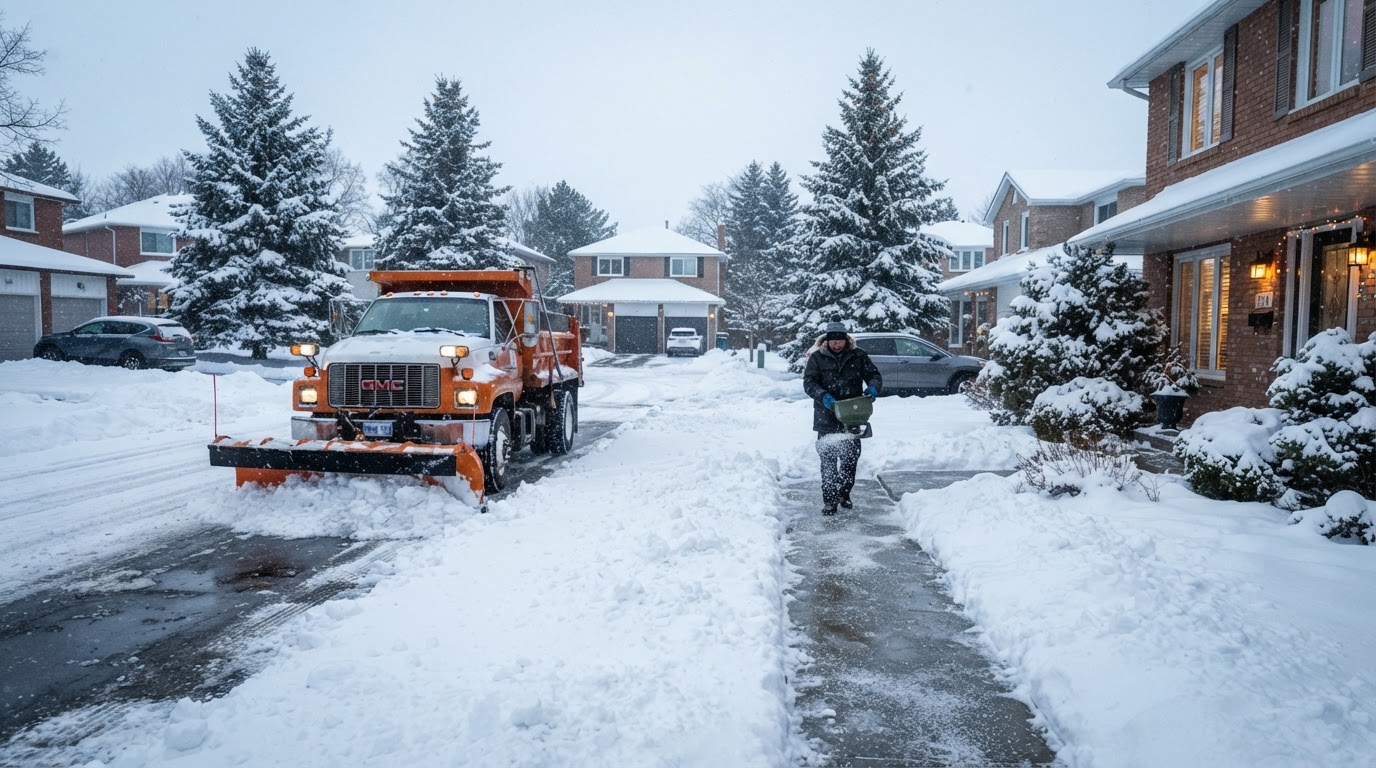
De-icing is the set of methods and materials used to break the bond between ice and surfaces, restore safe access, and reduce slip hazards across properties. At its core, de-icing works by lowering the freezing point of water, applying mechanical force to remove bulk snow and ice, or adding heat where prevention is critical, and those mechanisms deliver faster clearing, improved safety, and reduced liability for homeowners and property managers. This guide explains chemical, mechanical, and thermal approaches in practical terms, compares common de-icing chemicals and eco-friendly alternatives, and provides surface-specific decision rules tailored to the North GTA climate. Readers will learn temperature ranges, corrosion and environmental trade-offs, anti-icing timing, and how to choose methods for concrete, asphalt, pavers, driveways, walkways, and commercial lots. We also cover commercial best practices for Richmond Hill, Vaughan, Markham, and Aurora managers, plus safety tips to protect pets, plants, and infrastructure. The sections that follow unpack each method category, present comparison tables and decision matrices, and finish with a concise FAQ aimed at quick answers for featured snippets.
What Are the Main Types of De-Icing Methods Used in Winter Property Maintenance?
De-icing methods fall into three primary categories: chemical, mechanical, and thermal; each works by either changing ice chemistry, physically removing snow and ice, or applying heat to prevent bonding. Chemical de-icing lowers water's freezing point through salts and chemical agents, providing rapid melting across a range of temperatures and surface types. Mechanical de-icing—plowing, shoveling, scraping—removes bulk accumulation and prepares surfaces for chemical or thermal follow-up, increasing overall efficiency. Thermal systems apply embedded heating or portable mats to prevent ice formation on critical paths without chemicals, which is useful for ramps and sensitive areas. Each method provides specific benefits and combining them often yields the best outcome for different property scenarios, and the next subsections explain how each operates and when to prioritize them.
- Chemical de-icing lowers the freezing point of water to melt ice and prevent re-bonding on surfaces.
- Mechanical de-icing physically removes snow and ice to restore surface traction and allow chemicals to work faster.
- Thermal de-icing applies heat directly to surfaces to prevent ice formation without chemical residue.
- Combining these approaches reduces material use and increases reliability, so the next subsection explains chemical mechanics in more detail.
What Is Chemical De-Icing and How Does It Work?
Chemical de-icing works by delivering solutes—commonly salts or acetate-based chemicals—that depress water's freezing point, sometimes producing exothermic reactions that accelerate melting. Solid granular products like rock salt (sodium chloride) or calcium chloride are spread with spreaders, while liquid brines and sprayable solutions coat surfaces for anti-icing and rapid activation. The mechanism produces a brine layer that interrupts bond formation and loosens ice from the substrate, producing practical benefits such as faster clearing times and less manual scraping. Application timing matters: pre-treatment (anti-icing) prevents bonding, while reactive treatment removes existing ice; understanding this distinction improves efficiency and reduces overall chemical usage. Proper application also considers surface type and environmental sensitivity to limit runoff and corrosion.
How Do Mechanical De-Icing Methods Complement Chemical Solutions?
Mechanical de-icing—tools such as shovels, snow blowers, and plows—removes the majority of snow mass, lowering labor and material needs for subsequent chemical treatment. Removing bulk snow first shortens melt times because chemicals contact thinner ice layers and work more efficiently, reducing salt consumption and surface exposure. Mechanical work is essential on steep driveways and high-traffic parking lots where chemicals alone cannot clear compacted snow quickly enough. Combining mechanical and chemical tactics increases safety and cost-effectiveness, and the next subsection outlines when thermal systems become the preferred choice.
What Is Thermal De-Icing and When Is It Used?
Thermal de-icing includes heated pavement systems, electrically warmed mats, and portable radiant heaters that prevent ice formation by supplying controlled heat to vulnerable surfaces. Thermal solutions are preventive and chemical-free, ideal for critical walkways, wheelchair ramps, and building entrances where residue or corrosion is unacceptable. Installation and operating costs are higher than chemical or mechanical methods, so thermal is typically used selectively for high-value or safety-critical zones rather than across entire properties. Maintenance and energy considerations influence feasibility, and decisions about thermal options should weigh long-term safety benefits versus upfront investment and operational costs.
Which Chemical De-Icing Agents Are Most Effective for Commercial and Residential Properties?
Chemical de-icers vary by effective temperature range, speed, corrosivity, and environmental impact, so choosing the right agent requires balancing melting performance with surface and ecosystem safety. Sodium chloride (rock salt) is cost-effective but less effective below -9°C and is more corrosive to metals and concrete. Calcium chloride works at much lower temperatures and releases heat as it dissolves, making it fast-acting but more aggressive on some surfaces. Magnesium chloride offers an intermediate profile with lower corrosivity and improved safety for vegetation and pets. Specialty chemicals such as potassium acetate and urea serve niche roles where corrosion must be minimized, but they carry higher cost or nutrient runoff concerns. Below is a decision-friendly comparison table to summarize performance characteristics and typical uses for property teams and homeowners.
This comparison highlights trade-offs between cost, performance, and asset protection, and the following subsections discuss each chemical in practical terms.
The table below compares common chemical de-icers by key performance attributes to support quick decision-making.
| Chemical | Effective Temp Range | Pros | Cons | Typical Use Cases |
|---|---|---|---|---|
| Sodium chloride (rock salt) | ~ -9°C to 0°C | Low cost, widely available | Corrosive to metal, limited low-temp performance | Residential driveways, large parking lots in mild cold |
| Calcium chloride | ~ -25°C to -31°C | Fast-acting, exothermic melting | Higher corrosivity, can harm concrete/vegetation | Commercial lots, extreme cold conditions |
| Magnesium chloride | ~ -15°C to -5°C | Lower corrosion, safer for plants/pets | Less effective in extreme cold | Residential use, landscaped properties |
| Potassium acetate | ~ to -40°C (liquid-based) | Low corrosion, airport/tarmac-safe | High cost | Sensitive infrastructure, airports, bridges |
| Urea | ~ -5°C to 0°C | Lower corrosion on some metals | Fertilizer runoff concerns | Environmentally sensitive zones with careful dosing |
What Are the Benefits and Drawbacks of Rock Salt?
Rock salt (sodium chloride) melts ice by creating a brine that lowers freezing point and is favored for its affordability and availability. Its main benefit is cost-effectiveness on large, low-value surfaces where frequent reapplication is feasible and temperature hovers near freezing. Drawbacks include limited efficacy in deep cold, damage potential to vehicles and metal fixtures, and negative impacts on nearby vegetation and waterways from chloride runoff. Best practices for rock salt include targeted application rates, avoiding use near sensitive plantings, and combining with mechanical clearing to reduce required quantities. Understanding these limits informs when to choose alternatives for long-term asset protection.
How Does Calcium Chloride Perform in Low Temperatures?
Calcium chloride performs strongly in severe cold by attracting moisture and releasing heat as it dissolves, enabling melting at much lower temperatures than rock salt. Its exothermic action means quicker penetration of compacted ice and faster clearing of parking areas and critical pathways in deep-freeze events. However, calcium chloride's aggressive chemical nature increases the risk of surface scaling on concrete and can stress vegetation if overapplied, so careful dosing and post-season rinse protocols are important. For commercial managers, calcium chloride is valuable for rapid response in extreme cold, provided corrosion mitigation and runoff controls are in place.
Why Is Magnesium Chloride Considered an Eco-Friendlier Option?
Magnesium chloride offers a compromise between melting performance and environmental sensitivity, reducing corrosivity compared with sodium chloride while maintaining effective melting at moderately low temperatures. Its lower salt index diminishes metal corrosion and plant damage risks, making it suitable for landscaped residential areas and properties with pet traffic. Cost and effectiveness in very low temperatures remain limitations, so magnesium chloride is best when balancing performance with infrastructure and ecological concerns. Choosing magnesium chloride often reflects a property's priority on reduced long-term damage and occupant safety.
What Are Other Chemical Alternatives Like Potassium Acetate and Urea?
Potassium acetate and urea serve niche markets where corrosion and residue must be minimized, such as airports, sensitive industrial sites, or landscaped campuses. Potassium acetate is highly effective and low-corrosive, but cost and potential oxygen-depleting effects in waterways demand careful application. Urea is less corrosive on some metals but can act as a nutrient source for algae when runoff enters water bodies, requiring management near waterways. These alternatives are chosen despite higher cost when asset protection or regulatory restrictions make traditional salts unacceptable.
After weighing chemical trade-offs, many property providers select blends and application methods to match site priorities; Lush Lawncare and Landscaping uses combinations of mechanical clearing, liquid anti-icing, and carefully chosen de-icers to optimize safety, minimize corrosion, and control environmental risk while tailoring treatments to client budgets and property constraints. For property managers interested in a professional evaluation and tailored product selection, requesting a site assessment can clarify the best balance for specific assets.
How Do Eco-Friendly De-Icing Solutions Compare to Traditional Chemicals?
Eco-friendly de-icers such as beet juice additives, calcium magnesium acetate (CMA), liquid brines, and traction materials like sand offer reduced corrosion and lower ecological impact, but they vary in melting power and cost. These alternatives often function as additives to brine solutions or as traction aids rather than full replacements for high-performance chemical melts in extreme cold. Choosing eco-options reduces infrastructure damage and pet/plant exposure, yet decision-makers must weigh higher cost, availability, and sometimes lower melt efficiency. The table below compares eco-friendly options against traditional chemicals on environmental and safety dimensions.
This comparison shows eco-options can reduce long-term infrastructure and environmental harm when integrated correctly, and the following subsections explain specific eco-choices in context.
This table summarizes eco-friendly de-icers to compare environmental impact, surface safety, pet/plant safety, and availability for practical selection.
| Product | Environmental Impact | Surface Safety | Pet/Plant Safety | Cost/Availability |
|---|---|---|---|---|
| Calcium magnesium acetate (CMA) | Low runoff toxicity | Low corrosivity | High safety for plants/pets | Higher cost, moderate availability |
| Beet juice blends | Biodegradable additive | Reduced corrosion when mixed | Generally safer but may stain | Growing availability, higher cost |
| Liquid brine (salt/brine mix) | Lower solid runoff, targeted use | Less abrasive residue | Variable, depends on mix | Cost-effective for anti-icing, widely used |
| Sand/grit | Minimal chemical impact | No melting, can abrade surfaces | Safe for plants, may clog drains | Low cost, high availability |
What Are the Advantages of Beet Juice and Calcium Magnesium Acetate?
Beet juice additives and CMA reduce corrosivity and improve liquid adhesion for brines, extending anti-icing performance while lowering chloride loads to soil and waterways. Beet juice acts as a sticky carbohydrate carrier that improves brine retention on surfaces, reducing wash-off and chemical loss during light storms. CMA is a chloride-free solid that offers excellent corrosion control and is often specified where metal asset protection is crucial. Limitations include higher material cost and variable low-temperature performance, so these products are most effective when used strategically as part of an integrated plan emphasizing environmental protection. Understanding their role as additives or selective replacements helps managers meet sustainability goals.
How Do Liquid De-Icers and Brine Solutions Improve Ice Management?
Liquid de-icers and pre-treatment brines prevent bond formation by coating pavement before snowfall, which reduces chemical quantities needed and shortens clearing time during events. Equipment like sprayers and truck-mounted tanks enable even application, creating a thin anti-icing layer that blocks snow from adhering and allows mechanical plows to remove accumulations more completely. Pre-treatment shifts strategy from reactive to preventive, improving safety and reducing total material use over a season. Proper calibration and timing are critical: accurate rates and forecast-based application maximize efficiency while limiting environmental exposure.
What Role Does Sand Play in Eco-Friendly Traction and Ice Control?
Sand and grit provide immediate traction without chemical melting and are useful on steep driveways, icy stairs, and short-term problem spots where melting is impractical. While sand does not melt ice, it improves friction and safety until mechanical clearing or melting occurs, and it avoids chemical runoff concerns. Drawbacks include cleanup needs, potential clogging of drains, and reduced long-term effectiveness compared with melting agents. Combining sand with targeted brine or chemical application offers a balanced approach where traction plus limited melting is desirable.
How to Choose the Best Ice Melt for Driveways and Walkways in the North GTA?
Choosing the right ice melt requires assessing temperature range, surface material, traffic patterns, proximity to vegetation, and local environmental priorities; matching these factors to chemical properties yields safer, cost-effective results. For concrete surfaces in North GTA freeze-thaw cycles, lower-corrosive options or reduced application rates help protect against scaling. Asphalt and pavers tolerate some salts better but still benefit from anti-icing and mechanical clearing to limit long-term residue. Prioritizing high-traffic zones for rapid-response products and using eco-options near landscaped areas balances safety and asset preservation. The decision matrix below helps pair surface type, typical temperature ranges, and recommended methods for common local scenarios.
This decision matrix clarifies practical choices for local property types and leads into factors that most influence selection.
Use this decision matrix to match surface type and temperature to recommended de-icing strategies and notes on corrosion and residue.
| Surface Type | Typical Temp Range | Recommended Method | Notes on Corrosion/Residue |
|---|---|---|---|
| Concrete driveway | -10°C to 0°C | Magnesium chloride or brine anti-icing | Use lower rates and post-season rinse to limit scaling |
| Asphalt parking lot | -15°C to 0°C | Rock salt combined with mechanical clearing | Monitor for potholes; repair and seal in spring |
| Stone pavers/walkways | -10°C to 0°C | Beet-juice brine or CMA blends | Avoid heavy rock salt that stains or dislodges sand joints |
| Steep driveway/steps | -20°C to 0°C | Calcium chloride for rapid melting + sand traction | Protect adjacent plantings with buffer zones |
What Factors Affect the Choice of De-Icing Method for Different Surfaces?
Surface material dictates chemical tolerance, freeze-thaw vulnerability, and acceptable residue levels; concrete is more prone to scaling from chloride exposure, while asphalt can soften with certain de-icers and pavers can lose joint sand. Traffic level and loading influence whether fast-acting chemicals or preventive brines are preferable, and nearby plants or watercourses necessitate lower-chloride or alternative products. Sealed surfaces and protective coatings expand options, but regular monitoring and maintenance reduce cumulative damage. Recognizing these interactions guides property-specific plans and informs the next topic on temperature influences.
How Do Temperature and Weather Conditions Influence De-Icer Effectiveness?
Temperature thresholds determine which chemicals will perform: rock salt loses effectiveness below roughly -9°C, magnesium chloride is useful in moderate cold, and calcium chloride remains effective in extreme low temperatures. Weather patterns—such as freeze-thaw cycles, sleet, or heavy wet snow—change application timing and material choice because repeated cycles increase damage risk and complicate removal. Anti-icing before expected precipitation prevents bonding and often reduces total chemicals needed, while reactive treatments must consider residual brine and runoff. Matching products to forecasted conditions optimizes safety and cost.
What Are the Environmental and Safety Considerations for Property Managers?
Property managers must weigh runoff risks, pet and plant exposure, and corrosion impacts on infrastructure when selecting de-icers and application strategies. Mitigation tactics include buffer zones around plantings, targeted application rates, use of less-corrosive agents near metal fixtures, and post-season cleaning to remove residues. Documentation of products and methods supports compliance and liability management for commercial sites, and monitoring runoff or soil health after heavy winter seasons can guide adjustments. Implementing these practices reduces environmental footprint and preserves long-term asset value.
What Are the Best Commercial De-Icing Methods for Property Managers in Richmond Hill, Vaughan, Markham, and Aurora?
Commercial de-icing for North GTA managers emphasizes integrated snow removal contracts, anti-icing schedules, and prioritization of high-traffic zones to balance safety, compliance, and cost. Effective plans combine pre-treatment brine applications, mechanical plowing, targeted chemical spot-treatments, and clear documentation of service-level agreements to protect public access and reduce liability. Seasonal contracts with set response thresholds and prioritized zones yield predictable budgeting and faster operational response. The following subsections outline operational sequencing, cost-saving tactics, and how tailored service offerings support commercial needs.
- Prioritize anti-icing and high-traffic zones to reduce total material use and response time.
- Integrate mechanical snow removal with targeted chemical applications for efficiency.
- Maintain documentation and SLAs in contracts to support compliance and liability protection.
- These strategies collectively reduce winter risk and move into operational sequencing details in the next subsection.
How Does Professional Snow Removal Integrate with De-Icing Services?
Professional snow removal integrates pre-treatment, plowing, and spot de-icing in a defined sequence to maximize safety and minimize costs: anti-icing before events, mechanical removal of bulk snow, then targeted de-icing for residual ice. This workflow reduces material consumption and labor by preventing hard bonding and allowing plows to clear more effectively. Service-level agreements should define triggers, response times, and documentation procedures to protect property owners and meet regulatory expectations. Combining anti-icing with mechanical services also reduces environmental exposure by lowering the total chemicals applied.
What Cost-Effective Strategies Ensure Winter Safety and Compliance?
Cost-effective commercial approaches include bulk brine production or procurement, scheduled anti-icing for recurring trouble zones, and prioritizing loading docks, main entrances, and pedestrian paths for immediate response. Inventory management and forecasting lower emergency purchases, while targeted application rates and prioritized zoning reduce waste. Contract structures that offer seasonal plans with defined priorities often produce better ROI than per-visit billing for high-frequency winter weather. These strategies optimize both safety and budget predictability.
How Does Lush Lawncare Tailor De-Icing Solutions for Commercial Properties?
Lush Lawncare and Landscaping provides tailored commercial offerings that combine site assessments, seasonal planning, and blended method execution to meet North GTA property manager needs. Their approach emphasizes combining mechanical snow removal with liquid anti-icing and carefully selected de-icing products to match surface types and local microclimates, delivering focused safety where it matters most. Offerings include seasonal contracts and emergency response options that document actions for compliance, and this client-focused tailoring helps managers control costs while meeting safety requirements. Property managers seeking a professional plan often start with a site assessment to define priorities and recommended materials.
What Are the Safety Tips and Best Practices for Applying De-Icing Products?
Safe de-icer application relies on correct product choice, calibrated equipment, and measures to protect people, pets, plants, and infrastructure from harm. Applying only recommended rates prevents overuse and runoff, while targeted placement reduces exposure to vegetation and avoids unnecessary corrosion near metal fittings. Use of appropriate PPE during handling, calibration of sprayers and spreaders, and post-season rinsing where needed support both safety and asset longevity. The following checklist provides clear, actionable best practices for homeowners and property managers.
Following these steps reduces risk and leads into specific protections for pets, plants, and concrete.
- Calibrate spreaders and sprayers before use to ensure even application and avoid over-application.
- Apply anti-icing brines before predicted precipitation to prevent bond formation and reduce total chemical use.
- Establish buffer zones near plantings and waterways, and use lower-chloride products in those areas.
How to Protect Pets, Plants, and Concrete During De-Icing?
Protect pets and plants by selecting lower-toxicity products near landscaping, rinsing salt from pet paws after walks, and creating buffer zones that keep chemicals away from sensitive beds. For concrete, avoid excessive use of high-chloride products and schedule post-winter rinsing to remove residues that accelerate scaling; use sealers on new concrete to further reduce damage risk. Educating occupants and posting visible safety reminders during treatment windows minimizes accidental exposure. These measures preserve both biological and built assets while maintaining winter safety.
What Equipment Is Used for Effective Liquid De-Icer Application?
Effective liquid application uses calibrated sprayers and truck-mounted tanks for even coverage, and smaller handheld units for narrow walkways and residential settings; spreaders handle granular products with controlled discharge rates. Calibration ensures correct liters or grams per square meter, preventing waste and limiting environmental impact. Professional operators maintain equipment to prevent leaks and ensure consistent flow patterns, which optimizes performance and reduces the need for repeat applications. Selecting appropriate equipment scale ties directly to property size and response expectations.
When Should Anti-Icing Be Applied to Prevent Ice Formation?
Anti-icing should be applied shortly before precipitation begins when forecasts predict temperatures near or below freezing, typically within a window of a few hours pre-event to ensure adhesion and prevent bonding. The ideal timing balances forecast certainty and logistical readiness: too early and the solution may wash away, too late and adhesion forms. Pre-treatment is especially effective on high-traffic areas and incline approaches where bonding creates major hazards. Coordinating anti-icing schedules with mechanical response plans yields the best preventative outcomes.
Within safety protocols, professional training and specialized equipment—such as calibrated sprayers and truck-mounted systems—are examples of the technician-level resources used by Lush Lawncare and Landscaping to implement safe, effective application plans for clients; managers can request tailored safety plans to document and reduce risk.
What Are Common Questions About De-Icing Methods Answered?
This FAQ section delivers concise, snippet-optimized answers to common queries about de-icing methods, focused on quick, practical guidance for homeowners and property managers in North GTA.
What Are the 3 Main Types of De-Icing?
The three main types are chemical de-icing, mechanical de-icing, and thermal de-icing, each defined by the mechanism used to remove or prevent ice formation. Chemical methods melt ice by lowering the freezing point, mechanical methods remove snow and ice physically, and thermal is best for targeted, residue-free prevention. Knowing these distinctions guides appropriate method selection.
What Is the Most Effective De-Icing Method for Driveways?
The most effective driveway method depends on temperature and surface: in mild cold, a combination of mechanical clearing plus anti-icing brine or magnesium chloride works well; in deep cold, calcium chloride followed by mechanical removal may be necessary. For steep driveways, add traction materials like sand while treating melting-resistant ice. Prioritize anti-icing to prevent hard bonding and reduce total chemical use. Match method to local conditions for best results.
Which De-Icer Is Safest for Pets and Plants?
Magnesium chloride, CMA, and beet-juice blends are generally safer options for pets and plants compared with sodium chloride due to lower corrosivity and chloride load. Even with safer products, limit direct contact, use buffer zones, and rinse exposed foliage when practical. Applying the minimum effective rate further reduces exposure. These practices help balance safety with effective ice control.
How Does Liquid De-Icer Application Work?
Liquid de-icers are sprayed to create a thin, adherent film that prevents snow and ice from bonding to pavement; this pre-treatment allows plows to clear snow more effectively and reduces granular usage. Application requires calibrated sprayers and correct timing relative to forecasted precipitation for maximum effect. Liquid treatments also distribute more evenly than granular methods, lowering localized over-application and runoff. Properly implemented liquid anti-icing reduces total winter maintenance effort.
How Can Property Managers Reduce Corrosion from De-Icing Chemicals?
Managers reduce corrosion by choosing lower-corrosive agents, applying corrosion inhibitors where appropriate, rinsing surfaces after winter, and using protective coatings or sacrificial mats on metal assets. Inventorying high-value items near treated zones and creating exclusion areas prevents unnecessary exposure. Regular monitoring and selecting products with documented lower corrosivity form a proactive approach to asset protection.
This completes the FAQ responses and ends the guide on de-icing methods.