
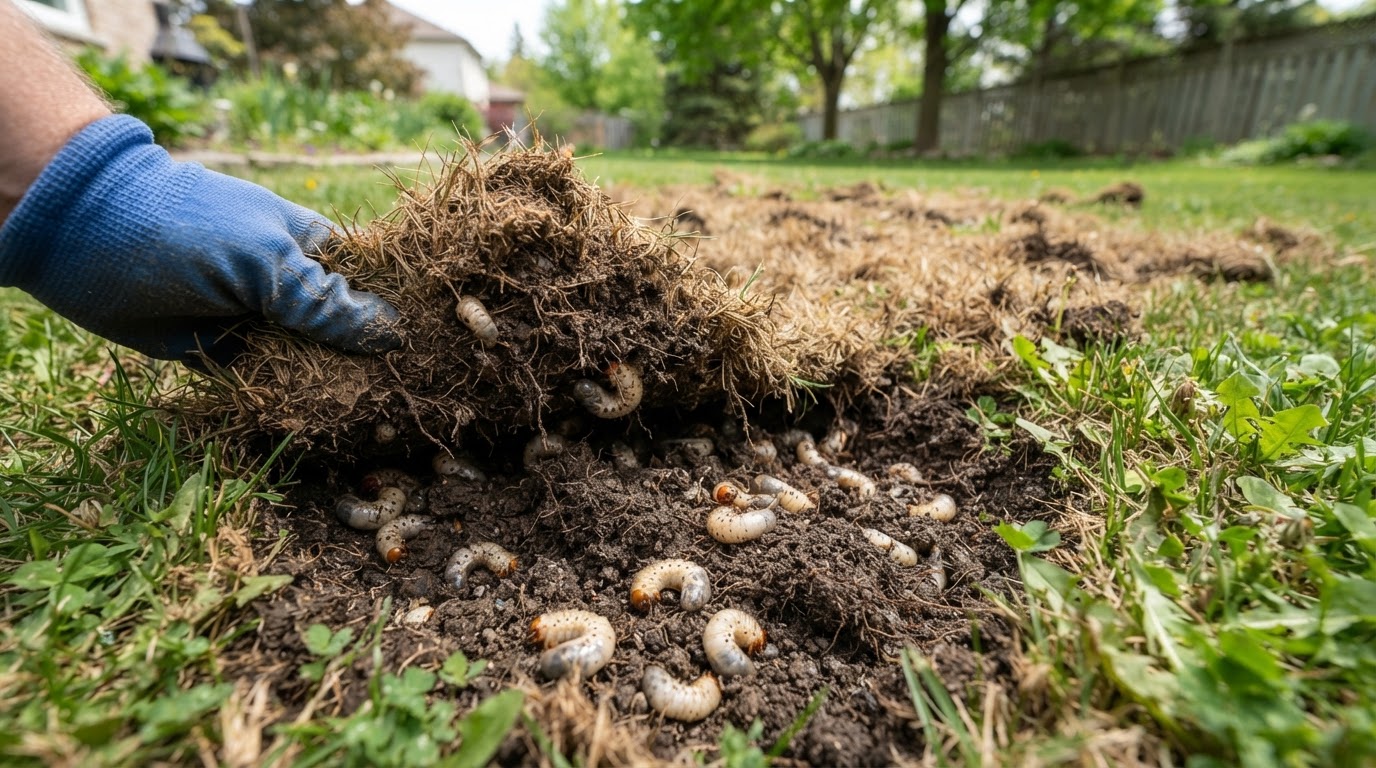
White grubs — the C-shaped larvae of European chafers and June beetles — are one of the most destructive turf pests in Ontario. They feed directly on grass roots, severing the lawn's connection to soil water and nutrients, and the damage they cause attracts secondary pests like skunks and raccoons that tear up the lawn overnight searching for a meal. By the time most homeowners notice the problem, large sections of turf are already destroyed. Across Richmond Hill, Aurora, Markham, Vaughan, and the GTA, grub damage is a recurring late-summer problem, but Ontario's cosmetic pesticide ban means you can't just spray a chemical and call it done. This guide covers how to identify grub damage, the safe and legal treatment options that actually work, and how to build a lawn that resists grubs naturally. With the right lawn care and fertilization approach, grub damage becomes a manageable problem instead of an annual disaster.
What Are White Grubs and Why Are They a Problem?
White grubs are the larval stage of several beetle species, with the European chafer being the most damaging in the GTA. Adult beetles lay eggs in the soil in early summer, and the grubs hatch and begin feeding on grass roots in late summer and fall. They continue feeding until the soil freezes, then burrow deeper to overwinter, and resume feeding in spring before pupating into adults. A single grub can chew through several grass plants' root systems, and a heavy infestation can have 50 to 100 grubs per square foot. The result is turf that has no roots — it browns, dies, and can be rolled back like a carpet. The animals that dig for grubs cause as much damage as the grubs themselves, tearing up large patches of lawn overnight.
Signs of Grub Damage
Catching grub damage early makes treatment far more effective. Here are the signs every York Region homeowner should watch for in late summer and fall.
- Spongy Turf:Walking on the lawn feels bouncy or soft because the roots have been chewed away. The grass has nothing anchoring it to the soil.
- Roll-Up Carpet Effect:In severe cases, you can lift dead patches of grass right off the soil like a piece of carpet. If the grass lifts easily, the roots are gone — grubs are the likely cause.
- Animal Digging:Skunks, raccoons, and birds tearing up your lawn overnight is the most visible sign. They're digging for the fat, protein-rich grubs beneath the surface. This secondary damage can destroy a lawn faster than the grubs themselves.
- Irregular Brown Patches:Browning that appears in late summer or fall, often in sunny areas of the lawn, can indicate grub feeding. The patches expand as the grubs spread.
Safe Biological Treatment with Beneficial Nematodes
Ontario's cosmetic pesticide regulations mandate safe, eco-friendly pest control, which means chemical grub killers are off the table for residential lawns. The most effective legal treatment is beneficial nematodes — microscopic roundworms that seek out and destroy grub larvae. Specifically, Heterorhabditis bacteriophora nematodes are applied as a liquid drench in late August or early September, when young grubs are small and close to the surface. The nematodes enter the grubs, kill them within 48 hours, and reproduce, providing ongoing control. The application must be done when soil temperatures are warm enough (above 15°C) and the lawn must be kept moist for the nematodes to survive and move through the soil. Timing and application technique are critical — nematodes applied too late, to dry soil, or in the wrong conditions simply don't work. This is why professional application produces far better results than DIY nematode kits.
Prevention: Building a Grub-Resistant Lawn
The best grub control is prevention, and a healthy, dense lawn is naturally more resistant to grub damage. Strong, deep root systems survive light grub feeding without visible damage, and dense turf is less attractive to egg-laying beetles. Building grub resistance starts with proper fertilization to promote deep root growth, annual aeration to relieve the compaction that limits root depth, and overseeding to maintain turf density. Proper watering — deep and infrequent — encourages roots to grow deeper, where grubs are less likely to reach them. A lawn with a complete care program can tolerate moderate grub populations without visible damage, while a neglected lawn is devastated by even a light infestation.
Repairing Grub Damage
If grubs have already destroyed sections of your lawn, repair follows a specific sequence. First, treat the remaining grubs with nematodes to stop ongoing damage — there's no point reseeding if the grubs will just eat the new roots. Once the grubs are controlled, rake out the dead grass, loosen the compacted soil, and add a thin layer of topsoil or compost. Overseed the bare areas with a quality grass blend suited to Ontario's climate, and keep the areas consistently moist until germination. For widespread damage, combine aeration, overseeding, and top dressing to rebuild the lawn comprehensively. The frustrating reality is that grub repair costs more than grub prevention — which is why an annual nematode application and a healthy lawn program are the smartest long-term investment.
The Complete Grub Management Timeline
- June-July:Adult beetles lay eggs. Maintain lawn health and monitor for beetle activity around dusk.
- August:Apply beneficial nematodes when grubs are small and near the surface. This is the critical treatment window.
- September-October:Monitor for damage signs. Treat if needed. Prepare for winter with proper fertilization.
- March-April:Grubs resume feeding as soil warms. Check for spring damage and overseed bare areas.
- Year-round:Maintain a healthy lawn through fertilization, aeration, and proper watering to build natural resistance.
Professional Grub Control for York Region Lawns
Effective grub control requires precise timing, proper nematode application, and a healthy-lawn foundation — and getting any of these wrong wastes time and money. Our team provides professional nematode application and complete lawn care programs for homeowners across Richmond Hill, Aurora, Markham, Vaughan, and Newmarket. We time the treatment to the grub life cycle, apply nematodes under optimal conditions, and build the fertilization and aeration foundation that prevents future infestations. If your lawn is showing signs of grub damage — or if you want to prevent it before it starts — request a free estimate and let's protect your lawn the safe, effective, Ontario-legal way.